

AGAINST THE ODDS: HOW AKWA IBOM’S TUBERCULOSIS PROGRAMME EARNED GLOBAL RECOGNITION—AND WHY THE FIGHT MUST CONTINUE

Share
By Mfon Jacott
International recognition often shines a spotlight on achievements that have long gone unnoticed. For the Akwa Ibom State Tuberculosis, Leprosy and Buruli Ulcer Control Programme (AKSTBLCP), its nomination for the prestigious Kochon Prize is not merely an honour—it is a global affirmation that years of quiet dedication, innovation and partnership are making a difference in one of the world’s most persistent public health challenges.
Established in 2006 by the Kochon Foundation in partnership with the Stop TB Partnership, the Kochon Prize is the world’s largest award dedicated exclusively to tuberculosis (TB). Accompanied by a US$65,000 prize and a commemorative medal, it recognizes individuals, organizations and partnerships whose outstanding contributions have advanced the global fight against TB. Named after the late Korean philanthropist Mr. Chong-Kun Lee, fondly known by his pen name “Kochon,” the award celebrates excellence, innovation and leadership in tuberculosis prevention, care and control.

The 2026 Kochon Prize focuses on organizations and programmes that successfully integrate TB prevention, diagnosis, treatment and care with broader health services to improve early detection, patient outcomes and health system performance. AKSTBLCP’s nomination reflects the Programme’s commitment to this integrated approach and places Akwa Ibom among programmes receiving international attention for advancing people-centred tuberculosis care.
The significance of this recognition becomes even clearer when viewed against the scale of the challenge. Nigeria remains among the world’s highest tuberculosis burden countries and carries the highest TB burden in Africa. Within Nigeria, Akwa Ibom is classified by the National Tuberculosis, Leprosy and Buruli Ulcer Control Programme as one of the priority states contributing substantially to the country’s TB burden. The World Health Organization estimates Nigeria’s TB incidence at about 219 cases per 100,000 population, highlighting the urgency of sustained investment in prevention, early diagnosis and treatment.
According to programme data, Akwa Ibom records well over 10,000 tuberculosis cases annually, while more than 3,200 new cases were identified during the first four months of a recent reporting period. These figures underscore both the magnitude of the challenge and the effectiveness of intensified case-finding efforts. Encouragingly, improvements in programme performance have increased TB case detection to over 90 per cent, while free TB testing, diagnosis and treatment continue to be provided through public health facilities across the state.
These statistics are not merely numbers; they represent thousands of lives that can be saved through early diagnosis, timely treatment and sustained community engagement.
Across all 31 Local Government Areas, AKSTBLCP has steadily transformed tuberculosis services by taking healthcare beyond hospital walls and into communities where the burden of the disease is often greatest. Through active case finding, household contact tracing, childhood TB screening during Maternal and Child Health Week, deployment of portable digital X-ray technology, community outreach and integrated healthcare delivery, the Programme has expanded access to life-saving services for thousands of residents.
At the heart of this transformation is the leadership of Dr. Nsisong Asanga, the Programme Manager, whose vision has strengthened collaboration across HIV, Malaria, Nutrition, Neglected Tropical Diseases, Epidemiology, Disease Surveillance and other public health programmes. Under his leadership, AKSTBLCP has embraced innovation, strengthened partnerships and promoted evidence-based interventions that have improved early diagnosis, expanded access to care and enhanced programme performance.
Dr. Asanga’s leadership has also fostered stronger collaboration with development partners, Local Government TB teams, healthcare workers, community volunteers, traditional institutions, faith-based organizations, civil society groups and the media. This collaborative approach has helped position Akwa Ibom as a model for integrated TB service delivery and earned the respect of national and international stakeholders.
The Programme’s achievements equally reflect the unwavering commitment of the Akwa Ibom State Government under the leadership of His Excellency, Pastor Umo Eno, PhD, the Honourable Commissioner for Health, Dr. Emmanuel Ekem John, the Permanent Secretary, Dr. Patrick Essiet, former Programme Managers, healthcare workers and every partner whose contributions continue to strengthen the state’s response to tuberculosis, leprosy and Buruli ulcer.
Yet, despite these achievements, tuberculosis remains one of the leading infectious disease threats in Nigeria. International recognition alone will not end the epidemic. What will make the difference is sustained investment, stronger local ownership and broader stakeholder participation.
The Kochon Prize nomination therefore presents an opportunity for governments, legislators, local government councils, corporate organisations, financial institutions, development partners, foundations, philanthropists and sons and daughters of Akwa Ibom, both at home and in the diaspora, to invest in a programme that has demonstrated measurable impact and earned international recognition.
Greater support will enable AKSTBLCP to expand community awareness campaigns, mobile screening services, diagnostic capacity, healthcare worker training, operational research, digital innovations and outreach to underserved communities. Every investment will help detect more cases early, interrupt transmission, save lives and strengthen the state’s health system.
For AKSTBLCP, the Kochon Prize nomination is not the destination—it is the beginning of a new chapter. It is an opportunity to transform global recognition into stronger local partnerships, sustainable financing and renewed determination to eliminate tuberculosis.
Ending tuberculosis is a shared responsibility. Government cannot do it alone. Development partners cannot do it alone. Healthcare workers cannot do it alone. Communities, businesses, philanthropists and citizens all have a vital role to play.
The world has recognised Akwa Ibom’s progress. Now is the time for every stakeholder to help write the next chapter—one in which international recognition is matched by sustained local commitment, stronger partnerships and healthier communities.
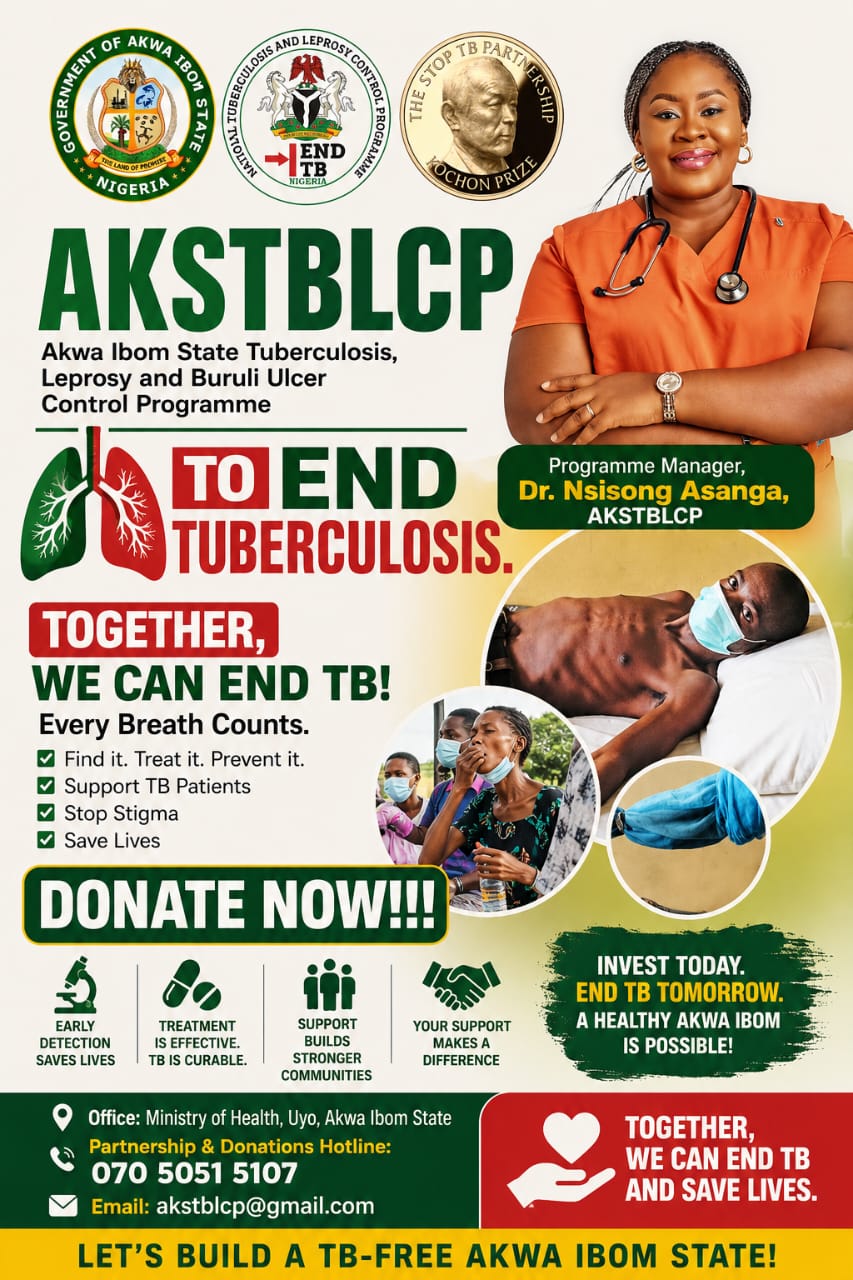
PARTNER WITH AKSTBLCP
The Akwa Ibom State Tuberculosis, Leprosy and Buruli Ulcer Control Programme welcomes partnerships, corporate social responsibility initiatives, grants and donations to sustain and expand tuberculosis, leprosy and Buruli ulcer control services across Akwa Ibom State.
Partnership & Donations Hotline: 070 5051 5107
Email: akstblcp@gmail.com
AKSTBLCP Office
Ministry of Health
Uyo, Akwa Ibom State
Together, we can detect tuberculosis earlier, save more lives and build an Akwa Ibom free from tuberculosis, leprosy and Buruli ulcer.
.